
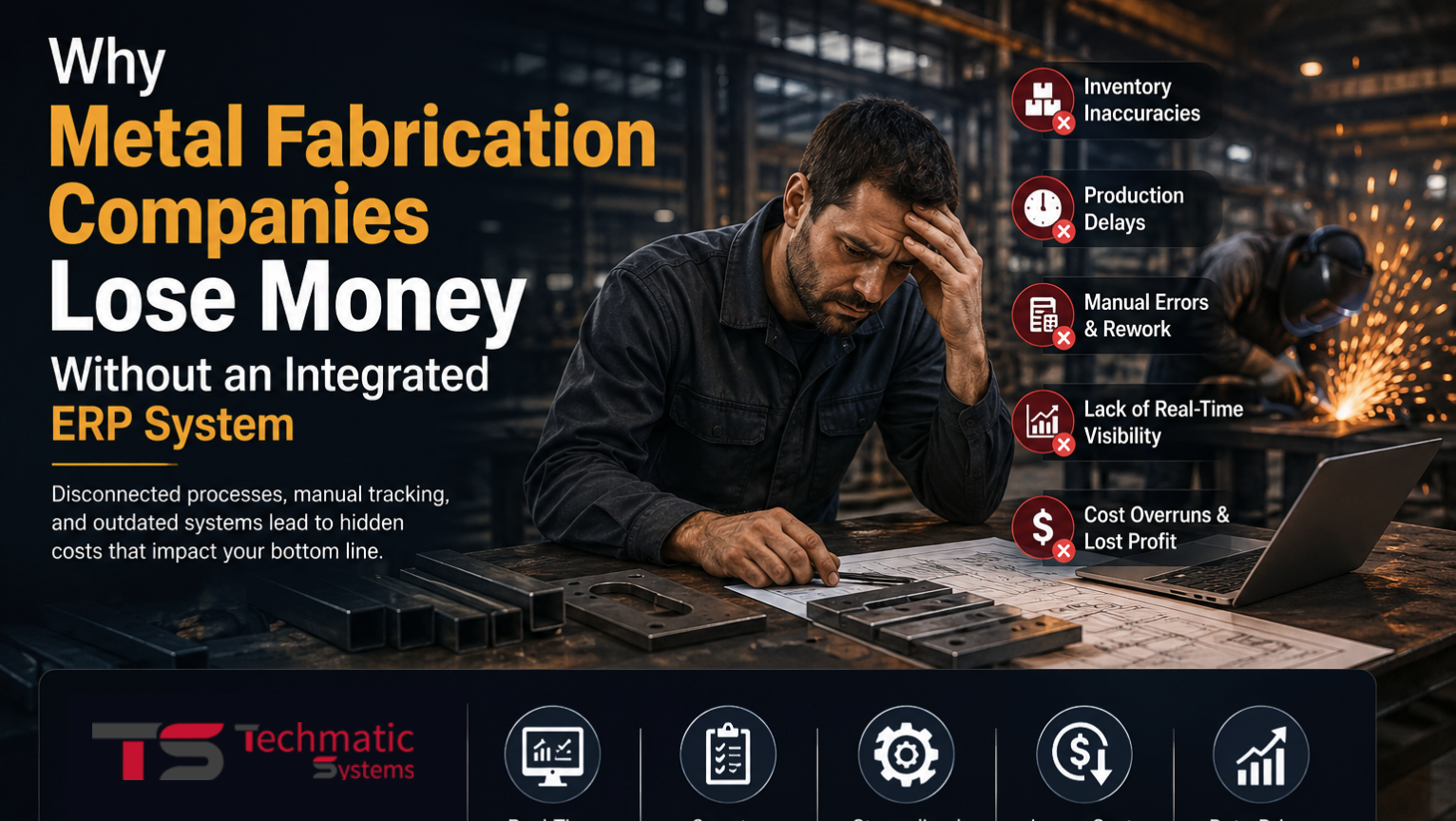
The metal fabrication industry operates on tight margins, complex production processes, and constantly changing customer requirements. Whether you’re producing structural steel, sheet metal components, custom assemblies, or precision parts, every delay, inventory mistake, or production error directly impacts profitability.
Yet many fabrication businesses still rely on spreadsheets, disconnected software, or manual processes to manage their operations. While these methods may seem manageable during the early stages of growth, they often become the biggest reason companies lose money as production scales.
An integrated Metal Fabrication ERP eliminates these inefficiencies by connecting every department from sales and inventory to production, procurement, and accounting—into a single platform.
In this article, we’ll explore why fabrication companies lose revenue without an ERP system and how implementing the right ERP for Metal Fabrication can improve productivity, reduce costs, and increase profitability.
The Hidden Cost of Running a Fabrication Business Without ERP
Many fabrication companies don’t realize how much money they’re losing because the losses happen in small amounts every day.
Common challenges include:
- Production delays
- Material shortages
- Overstocked inventory
- Inaccurate job costing
- Manual data entry
- Poor communication between departments
- Missed delivery deadlines
- Rework due to outdated drawings
While each issue may appear minor individually, together they significantly reduce operational efficiency and profit margins.
An integrated Manufacturing ERP helps eliminate these hidden costs by ensuring every department works with accurate, real-time information.
1. Poor Inventory Management Leads to Higher Costs
Raw materials such as steel, aluminum, copper, and specialty metals represent one of the largest expenses in fabrication businesses.
Without a centralized system, companies often experience:
- Overstocking materials that sit unused
- Running out of critical inventory
- Emergency purchases at higher prices
- Duplicate purchasing
- Lost materials on the shop floor
A modern Fabrication Management Software tracks inventory in real time across warehouses, production lines, and purchase orders.
This enables businesses to:
- Maintain optimal stock levels
- Reduce inventory carrying costs
- Improve procurement planning
- Prevent production stoppages
2. Inaccurate Job Costing Reduces Profit Margins
Many fabrication companies underestimate the actual cost of each project.
Manual costing often excludes:
- Machine time
- Labor hours
- Scrap material
- Tooling costs
- Rework expenses
- Overhead allocation
As a result, companies quote projects below actual production costs.
An integrated Metal Fabrication ERP automatically collects production data and calculates accurate job costs throughout the manufacturing process.
With real-time costing, businesses can:
- Create more profitable quotations
- Track actual vs estimated costs
- Identify high-cost operations
- Improve pricing strategies
3. Production Delays Impact Customer Satisfaction
Customers expect accurate delivery dates.
Without connected scheduling systems, fabrication shops often struggle with:
- Machine conflicts
- Resource shortages
- Delayed approvals
- Missing raw materials
- Inefficient production sequencing
An ERP for Metal Fabrication connects sales, inventory, production planning, purchasing, and shop floor operations.
Production managers gain visibility into:
- Machine availability
- Workforce capacity
- Material readiness
- Work order progress
This helps reduce delays while improving on-time delivery performance.
4. Manual Processes Create Expensive Errors
Many fabrication companies still use spreadsheets for:
- Production scheduling
- Inventory tracking
- Purchase orders
- Work orders
- Quality inspections
Manual data entry increases the risk of:
- Duplicate records
- Incorrect quantities
- Wrong production batches
- Outdated drawings
- Missing approvals
These errors often lead to scrap, rework, and delayed shipments.
With Fabrication Workflow Automation, repetitive manual tasks are replaced by automated workflows that improve speed and accuracy.
5. Lack of Real-Time Visibility Slows Decision-Making
Business owners need immediate access to operational data.
Without ERP, managers spend hours collecting reports from different departments.
Questions like these become difficult to answer:
- Which jobs are profitable?
- Which machines are overloaded?
- Where are production bottlenecks?
- Which materials are running low?
- Which customers generate the highest margins?
An integrated Manufacturing ERP provides real-time dashboards and reporting, enabling faster and more informed business decisions.
6. Communication Gaps Between Departments Cause Delays
In many fabrication companies, departments operate independently.
Sales promises delivery dates.
Production doesn’t receive updated customer requirements.
Purchasing isn’t informed about urgent material needs.
Accounting waits for manual production updates before invoicing.
These communication gaps lead to:
- Missed deadlines
- Customer complaints
- Delayed billing
- Increased operational costs
An integrated ERP ensures every department works from the same centralized database.
Everyone has access to the latest information, reducing errors and improving collaboration.
7. Inefficient Production Planning Reduces Capacity
Machine utilization directly affects profitability.
Without intelligent scheduling, businesses often experience:
- Idle machines
- Overtime labor
- Production bottlenecks
- Poor resource allocation
An Odoo Metal Fabrication solution allows production planners to optimize scheduling based on:
- Machine capacity
- Employee availability
- Material readiness
- Customer priorities
This improves production efficiency while maximizing equipment utilization.
8. Poor Quality Control Increases Rework
Quality issues are expensive.
Every defective part requires:
- Additional labor
- Extra materials
- Machine time
- Shipping delays
- Customer support
An integrated ERP helps standardize quality management through:
- Inspection checkpoints
- Digital quality records
- Non-conformance tracking
- Corrective action workflows
Reducing defects directly improves profitability.
9. Scaling Becomes Difficult Without Automation
As fabrication companies grow, manual processes become increasingly difficult to manage.
More customers mean:
- More work orders
- More inventory
- More suppliers
- More production planning
- More financial transactions
Without automation, businesses often need additional administrative staff simply to manage paperwork.
A scalable Custom ERP for Fabricators grows alongside the business without requiring proportional increases in administrative costs.
How Odoo ERP Helps Metal Fabrication Companies
Among today’s ERP solutions, Odoo ERP for Metal Fabricators has become a popular choice because of its flexibility and modular design.
Odoo connects every business function into one integrated platform, including:
- CRM
- Sales
- Purchasing
- Inventory Management
- Manufacturing
- Quality Control
- Maintenance
- Accounting
- Project Management
- Human Resources
Instead of managing multiple disconnected systems, fabrication companies operate through a single source of truth.
This improves operational efficiency while reducing software complexity.
Benefits of ERP in Metal Fabrication
Implementing the right ERP delivers measurable improvements across the organization.
Some of the biggest Benefits of ERP in Metal Fabrication include:
- Improved inventory accuracy
- Better production planning
- Faster order processing
- Accurate job costing
- Reduced production delays
- Lower operational costs
- Increased machine utilization
- Better quality control
- Real-time reporting
- Improved customer satisfaction
These advantages help businesses become more competitive while protecting profit margins.
Digital Transformation Is No Longer Optional
The fabrication industry is rapidly evolving.
Customers expect faster delivery. Material costs continue to fluctuate. Competition is increasing.
Businesses relying on disconnected software and manual processes struggle to remain profitable.
This is why Digital Transformation in Metal Fabrication has become a strategic priority rather than a future initiative. Companies investing in integrated ERP platforms gain greater operational visibility, stronger financial control, and improved scalability.
Why Choose Techmatic Systems for Metal Fabrication ERP Implementation?
Selecting the right ERP software is only part of the journey. Successful implementation requires industry expertise, process optimization, and ongoing support.
At Techmatic Systems, we specialize in Metal Fabrication ERP Implementation and Metal Fabrication ERP Consulting, helping manufacturers streamline operations with tailored Odoo ERP solutions. From production planning and inventory management to procurement, quality control, and financial reporting, our team configures the system to match your unique fabrication workflows.
Whether you’re looking for a Custom ERP for Fabricators, planning Fabrication Workflow Automation, or adopting Odoo ERP for Metal Fabricators, Techmatic Systems ensures a smooth implementation with minimal disruption to your business.
Our goal is simple: help metal fabrication companies reduce costs, improve efficiency, and build a scalable digital foundation for long-term growth.
Frequently Asked Questions
Why do metal fabrication companies need ERP?
A Metal Fabrication ERP integrates inventory, production, purchasing, sales, accounting, and quality management into one system. This reduces manual work, improves visibility, minimizes production delays, and helps companies increase profitability.
What are the benefits of ERP in metal fabrication?
ERP improves inventory accuracy, job costing, production planning, machine utilization, reporting, workflow automation, customer satisfaction, and overall operational efficiency while reducing unnecessary costs.
Is Odoo suitable for metal fabrication businesses?
Yes. Odoo ERP for Metal Fabricators offers modules for manufacturing, inventory, maintenance, purchasing, quality control, CRM, accounting, and project management, making it highly adaptable for fabrication companies of all sizes.
How long does Metal Fabrication ERP implementation take?
The implementation timeline depends on business size, process complexity, customizations, and data migration. Small and mid-sized fabrication companies can often go live within a few months when working with an experienced implementation partner like Techmatic Systems.