
Artificial intelligence is rapidly changing how businesses use ERP systems. Instead of manually searching for data or completing repetitive tasks, companies now use AI agents to retrieve information, automate workflows, and support decision-making. As organizations adopt AI, one question is becoming increasingly common:
Should you integrate AI with Odoo using traditional APIs or the Model Context Protocol (MCP)?
The answer depends on your business goals, scalability requirements, and the type of AI experience you want to deliver. This guide explains the differences between MCP and traditional APIs, helping you choose the right approach for Odoo AI integration.
What Is the Model Context Protocol (MCP)?
The Model Context Protocol (MCP) is an open standard that enables AI models and AI agents to securely interact with external applications, databases, and business systems like Odoo. Rather than creating a separate integration for every AI model, MCP provides a standardized way for AI to access business tools and data.
For businesses investing in AI, MCP simplifies development while making integrations more flexible and future-ready.
What Are Traditional APIs?
Traditional APIs (Application Programming Interfaces) have been the foundation of software integration for years. Odoo offers REST, XML-RPC, and JSON-RPC APIs that allow applications to exchange data and automate business processes.
Developers use Odoo API integration to connect ERP modules with websites, mobile apps, payment gateways, CRM platforms, and third-party software.
While APIs remain reliable, they were designed primarily for software-to-software communication not for AI agents that need context, reasoning, and dynamic interactions.
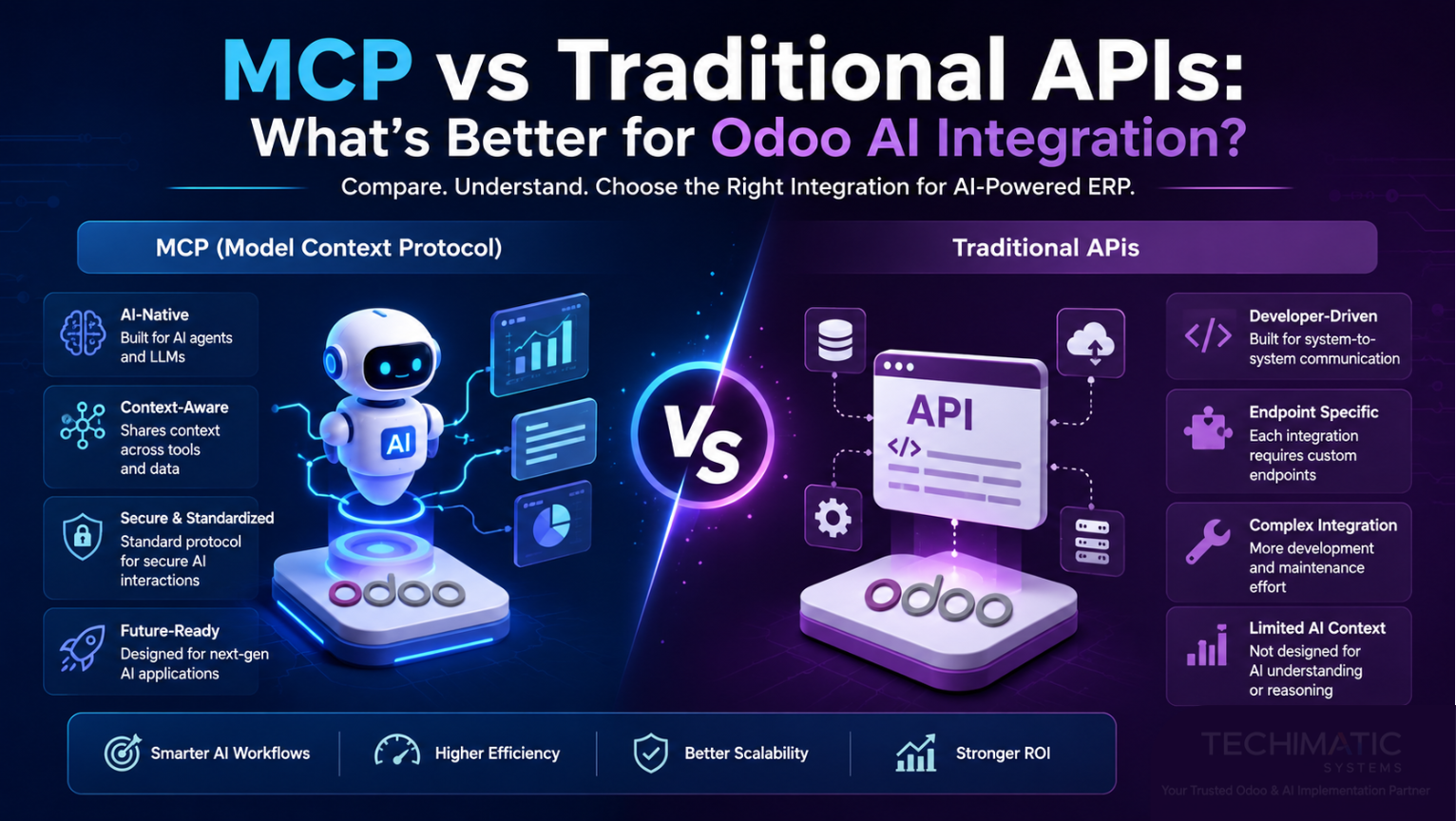
MCP vs Traditional APIs: Key Differences
| Feature | MCP | Traditional APIs |
| AI-Native Design | Yes | No |
| Standardized Communication | Yes | No |
| AI Agent Support | Excellent | Limited |
| Development Complexity | Lower | Higher |
| Context Sharing | Built-in | Manual |
| Future Scalability | High | Moderate |
Traditional APIs require developers to build custom integrations for every AI workflow. MCP introduces a common interface that allows AI systems to communicate with Odoo more efficiently.
Why MCP Is Gaining Attention for Odoo AI Integration
Businesses are moving beyond simple automation. Modern AI assistants can summarize sales reports, generate quotations, answer inventory questions, and trigger workflows inside Odoo.
Using MCP for Odoo ERP makes these capabilities easier to build because AI agents can securely access the business context they need without requiring multiple custom integrations.
For example, an AI assistant can:
- Retrieve customer information from Odoo CRM.
- Check inventory before confirming an order.
- Create purchase requests automatically.
- Generate financial summaries.
- Assist support teams with customer history.
These intelligent workflows are much harder to implement using standalone API calls alone.
When Traditional APIs Are Still the Better Choice
Traditional APIs remain an excellent solution when your business needs:
- Website or mobile application integration.
- Payment gateway connectivity.
- ERP synchronization with third-party platforms.
- Stable system-to-system communication.
- Legacy software integration.
If your objective is simply to exchange data between applications, traditional APIs continue to be reliable, secure, and cost-effective.
When Should You Choose MCP?
MCP becomes the better choice if your organization wants to:
- Integrate AI agents with Odoo ERP.
- Build AI copilots for employees.
- Enable natural language interaction with ERP data.
- Automate complex business processes using AI.
- Future-proof enterprise AI architecture.
As AI adoption grows, many organizations are expected to combine MCP with existing APIs rather than replacing APIs entirely.
Can MCP and Traditional APIs Work Together?
Yes. In fact, this is the approach many businesses are likely to adopt.
Traditional APIs continue handling structured business operations, while MCP provides AI agents with standardized access to those systems.
This hybrid architecture allows organizations to modernize their ERP without rebuilding existing integrations.
For example:
- APIs process transactions and update records.
- MCP enables AI assistants to understand business context and interact intelligently with Odoo.
This combination delivers both reliability and advanced AI capabilities.
Best Practices for Odoo AI Integration
To maximize the value of AI integration, businesses should:
- Define clear business objectives before implementation.
- Secure access to sensitive ERP data.
- Use standardized integration methods whenever possible.
- Monitor AI-generated actions and workflows.
- Design scalable architectures that support future AI models.
Whether you choose MCP or traditional APIs, proper planning is essential for long-term success.
Why Choose Techmatic Systems for Odoo AI Integration?
Implementing AI in Odoo requires more than connecting APIs, it demands a deep understanding of ERP workflows, business processes, and modern AI technologies. At Techmatic Systems, we help businesses build intelligent, scalable, and secure AI solutions that integrate seamlessly with Odoo.
Our expertise includes:
- Custom Odoo AI integration tailored to your business needs.
- AI agent development for CRM, Sales, Inventory, Accounting, HR, and Manufacturing.
- MCP (Model Context Protocol) implementation for AI-powered ERP interactions.
- Secure Odoo API integration with third-party applications and enterprise platforms.
- AI workflow automation to reduce manual tasks and improve operational efficiency.
- Ongoing support, optimization, and enhancements for long-term success.
Whether you’re looking to deploy an AI-powered copilot, automate complex business processes, or integrate advanced AI capabilities into your Odoo ERP, our team delivers solutions that are scalable, future-ready, and aligned with your business goals.
Ready to Modernize Your Odoo ERP with AI?
The future of ERP is intelligent, connected, and AI-driven. While traditional APIs remain essential for software integrations, Model Context Protocol (MCP) opens new possibilities for AI agents that can understand context, automate workflows, and enhance decision-making within Odoo.
Choosing the right integration strategy today will help your business stay competitive as AI continues to transform enterprise operations.
If you’re planning to integrate AI into Odoo, Techmatic Systems can help you design, develop, and deploy the right solution from AI agent implementation and MCP integration to custom Odoo development and enterprise automation. Contact our team to explore how AI can unlock greater efficiency and innovation across your organization.
Frequently Asked Questions
- What is the difference between MCP and traditional APIs for Odoo AI integration?
The primary difference is that traditional APIs are designed for application-to-application communication, while the Model Context Protocol (MCP) is built specifically for AI agents and large language models. MCP enables AI to understand context, access business tools securely, and perform intelligent actions within Odoo, making it ideal for AI-driven ERP automation.
- Should I use MCP or traditional APIs for Odoo?
Choose traditional APIs if you need to integrate Odoo with websites, mobile applications, payment gateways, or third-party software. Choose MCP if your goal is to build AI assistants, AI agents, or intelligent automation that interacts naturally with Odoo data and business processes.
- Can MCP and traditional APIs work together in Odoo ERP?
Yes. Many businesses adopt a hybrid integration strategy where traditional APIs handle standard system integrations, while MCP enables AI agents to retrieve information, automate workflows, and interact intelligently with Odoo. This approach combines reliability with advanced AI capabilities.
- What are the benefits of integrating AI agents with Odoo ERP?
Integrating AI agents with Odoo helps automate repetitive tasks, improve customer support, generate business insights, streamline inventory management, simplify accounting processes, and enable employees to interact with ERP data using natural language. This leads to increased productivity, faster decision-making, and improved operational efficiency.
- Is MCP secure for enterprise Odoo environments?
Yes. MCP is designed with secure communication practices and controlled access to enterprise systems. When implemented correctly alongside Odoo’s authentication and authorization mechanisms, it provides a secure framework for AI-powered business automation.