

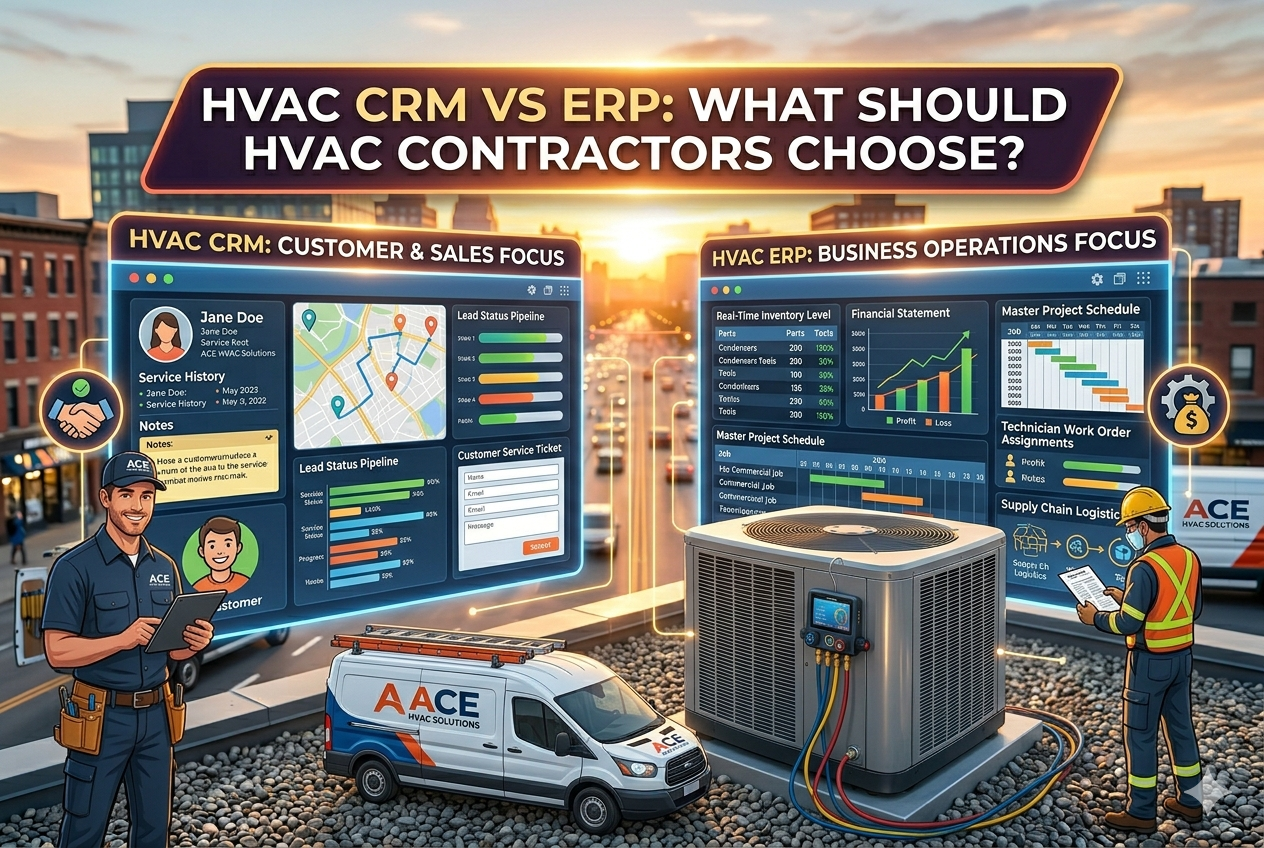
Choosing between an HVAC ERP and an HVAC CRM depends on how your contracting business operates today and where you want it to go next. A CRM helps you manage leads, customers, estimates, and follow-ups, while an ERP helps you control operations, scheduling, inventory, billing, and reporting in one connected system. For HVAC contractors, the right choice is usually the one that reduces manual work and supports growth without adding complexity.
Understanding the difference between HVAC ERP and CRM
An HVAC ERP goes beyond customer management. It connects the operational side of the business, including dispatching, inventory, purchase orders, invoicing, technician tracking, and business reporting. Instead of managing each function separately, an ERP brings them together so different teams can work from the same system.
An HVAC CRM is designed to help contractors manage customer relationships. It keeps track of leads, calls, service requests, estimates, follow-ups, and customer communication. For teams focused on sales and customer service, this can improve response speed and help close more business.
The main difference is simple: CRM helps you manage customers, while ERP helps you manage the full business process.
What HVAC CRM software does best
HVAC CRM software is a strong fit when your business needs better visibility into leads and service opportunities. It helps office staff follow up faster, track customer history, and avoid missed sales chances. This is especially useful for contractors who are still building a reliable customer base.
A CRM can also improve how your sales team handles estimates and reminders. When used properly, it supports smoother communication between the office and field teams. For smaller HVAC companies, this is often enough to create a more organized and professional customer experience.
If your business is still early in its growth, a CRM may be the most practical first step before moving to a broader ERP system.
When HVAC companies need ERP
HVAC companies usually start needing ERP when their operations become more complex. If your business is managing multiple technicians, service contracts, inventory movement, and billing across different jobs, a CRM alone may no longer be enough. At that stage, the company needs better HVAC operational management, not just customer tracking.
An ERP is especially useful when you want to reduce delays between departments. For example, once a service job is completed, the system can update job status, track inventory usage, trigger invoicing, and generate reports without manual follow-up. That kind of automation improves accuracy and saves time.
For growing contractors, ERP also supports better planning and control. It gives management a clearer view of performance, costs, and workflow efficiency across the business.
ERP vs CRM for HVAC contractors
The better choice depends on your current pain points. If your biggest issue is missed leads, poor follow-up, or disorganized customer data, CRM is likely the right fit. If your biggest issue is operational bottlenecks, disconnected systems, or manual reporting, ERP is the better solution.
| Business Need | Better Fit |
| Scheduling and dispatch | ERP |
| Inventory management | ERP |
| Billing and invoicing | ERP |
| Workflow automation | ERP |
| Department-wide visibility | ERP |
| Lead tracking | CRM |
| Customer follow-up | CRM |
| Service history | CRM |
| Estimates and sales pipeline | CRM |
In many HVAC businesses, CRM is the starting point and ERP becomes the next step as the company grows. That progression helps contractors adopt technology at the right time instead of overcomplicating operations too early.
Why HVAC ERP matters for growing B2B contractors
For B2B HVAC contractors, ERP is more than software, it is an operations framework. It helps companies manage jobs, teams, resources, and financial workflows in a structured way. This is especially valuable when you handle larger contracts, recurring service work, or multiple service locations.
A good HVAC ERP software platform can improve efficiency across departments. It helps teams work with fewer errors, better coordination, and more visibility into day-to-day performance. That makes it easier to scale without losing control of operations.
This is also where HVAC ERP implementation services become important. A strong system only delivers value when it is set up correctly, customized to your workflow, and integrated with the tools your team already uses.
How Techmatic Systems supports HVAC ERP implementation
At Techmatic Systems, the focus is on helping HVAC companies build better business systems through ERP. That includes HVAC ERP consulting services, HVAC ERP implementation services, HVAC ERP integration services, and HVAC ERP customization support based on real business needs. The goal is to create a setup that improves operations instead of adding more complexity.
For contractors comparing software, the right guidance can make a major difference. Some businesses need a full ERP rollout, while others need a phased approach that starts with core modules and expands over time. With the right implementation strategy, HVAC workflow management becomes smoother, faster, and easier to scale.
If you are looking for HVAC business management software that supports growth, Techmatic Systems can help you choose and implement the right solution for your operations.
Choosing the right system
The best system is the one that matches your current stage of growth. If your team mainly needs help with customer communication and sales tracking, start with CRM. If your business needs more control over operations, inventory, billing, and field coordination, ERP is the better long-term decision.
Many HVAC companies eventually need both customer-facing and operational tools. In that case, a flexible ERP platform that includes CRM capabilities may be the most efficient route. That allows your team to manage the full business in one place instead of using disconnected systems.
For contractors focused on growth, the decision should not be about software trends. It should be about which system will reduce friction and improve business performance.
If your HVAC business is still focused on lead handling and customer communication, CRM is a practical starting point. If your business is growing and you need stronger control over scheduling, inventory, billing, and operations, ERP is the smarter long-term choice. For HVAC contractors looking to scale efficiently, Techmatic Systems helps with ERP consulting, implementation, integration, and customization built for real business needs.
FAQs
- What is the difference between HVAC CRM and ERP?
HVAC CRM focuses on managing leads, customers, and follow-ups, while HVAC ERP handles broader operations like scheduling, inventory, invoicing, and workflow management.
- When do HVAC companies need ERP?
HVAC companies usually need ERP when their operations become more complex and they need better control over departments, jobs, inventory, and reporting.
- Can CRM and ERP work together for HVAC contractors?
Yes, many businesses use CRM and ERP together or choose an ERP platform that includes CRM features for a more complete workflow.
- What is the best HVAC CRM software?
The best HVAC CRM software is the one that helps your team manage leads, service history, and customer communication without slowing down daily work.
- Why is HVAC ERP important for B2B contractors?
HVAC ERP is important for B2B contractors because it improves coordination, reduces manual work, and gives better visibility across operations, finance, and field service.