

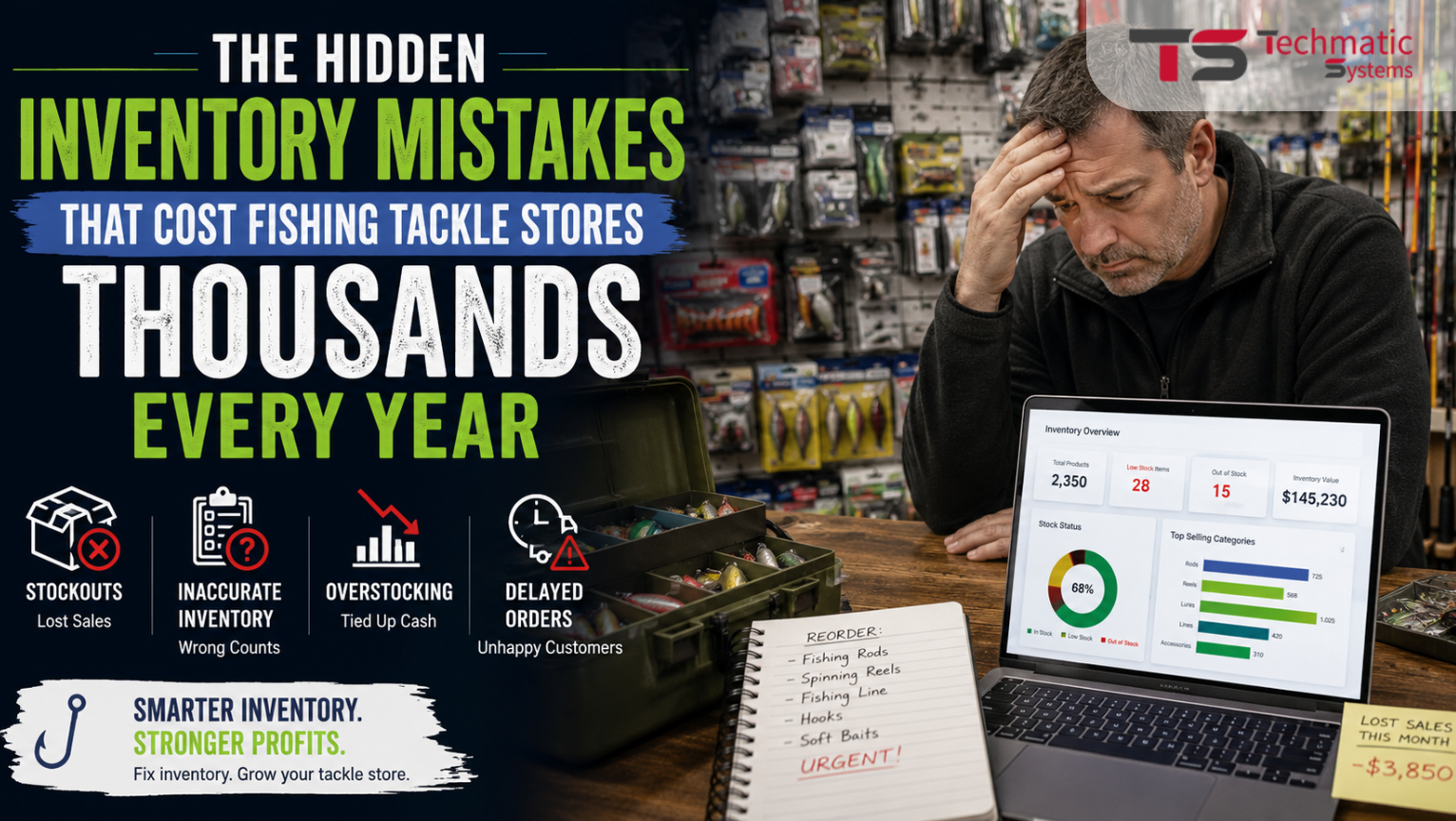
Inventory is the backbone of every successful fishing tackle store. Whether you operate a local bait and tackle shop or manage multiple retail locations, your inventory directly impacts sales, customer satisfaction, and profitability. Yet, many fishing retailers unknowingly lose thousands of dollars every year due to avoidable inventory mistakes.
From inaccurate stock counts and misplaced products to poor supplier coordination and seasonal overstocking, even minor inventory errors can snowball into major business challenges. Customers walk in expecting to find their favorite fishing rods, fishing reels, fishing lures, bait, and fishing accessories. When those products aren’t available even though your system says they are, you don’t just lose a sale, you risk losing a loyal customer.
As customer expectations continue to rise, relying on spreadsheets or basic retail software is no longer enough. Effective fishing tackle store inventory management requires real-time visibility, accurate inventory tracking, and smarter retail processes that help store owners make informed decisions.
At Techmatic Systems, we’ve worked with retailers looking to modernize their operations using Odoo Inventory Management. We’ve seen how businesses improve inventory accuracy, reduce manual work, and increase profitability simply by replacing disconnected systems with a centralized ERP solution.
In this guide, we’ll explore the common inventory mistakes in fishing tackle stores, explain why they happen, and share practical strategies to help you improve inventory performance while growing your business.
Why Inventory Management Matters More Than Ever
Inventory isn’t just about knowing what’s on your shelves. It’s about ensuring the right products are available at the right time, in the right quantities, without tying up unnecessary capital.
For fishing retailers, inventory management becomes even more challenging because demand changes throughout the year. Products that sell quickly during spring and summer may sit untouched during colder months, while seasonal events and local fishing tournaments can cause sudden spikes in demand.
Without proper inventory management for fishing tackle stores, it’s easy to experience:
- Lost sales due to unavailable products.
- Excess inventory occupying valuable shelf space.
- Delayed purchase orders.
- Inaccurate stock counts.
- Higher carrying costs.
- Reduced customer confidence.
The good news? Most of these problems are preventable with the right systems and processes.
1. Relying on Manual Inventory Tracking
Many independent tackle stores still use spreadsheets or handwritten logs to manage inventory. While this approach may work for a small number of products, it quickly becomes unreliable as your catalog grows.
Imagine trying to manually track hundreds or even thousands of SKUs, including fishing reels, rods, tackle boxes, live bait, and accessories. One missed update or incorrect stock entry can create a chain reaction of inventory errors.
This is where tackle store inventory software becomes invaluable.
Modern inventory software for tackle stores automatically updates stock levels whenever products are sold, received, returned, or transferred. Instead of spending hours counting inventory, your team gains real-time visibility into available stock.
Best Practice: Replace manual spreadsheets with an integrated inventory management system that updates stock automatically across every sales channel.
2. Poor SKU Management Creates Inventory Confusion
Every product in your store should have a unique Stock Keeping Unit (SKU). Without proper SKU management, employees may struggle to locate products, duplicate items may appear in your inventory, and reporting becomes unreliable.
This problem is especially common in fishing tackle stores where similar products are available in multiple sizes, colors, and brands.
For example, a single fishing lure may be available in ten different color combinations. If these products aren’t organized correctly, inventory mistakes become inevitable.
Effective SKU management helps you:
- Identify products quickly.
- Improve inventory tracking.
- Reduce picking errors.
- Simplify stock replenishment.
- Generate more accurate inventory reports.
3. Ignoring Seasonal Inventory Trends
Fishing is a seasonal business. Demand for fishing equipment changes based on weather conditions, regional fishing seasons, holidays, and local tournaments.
Many retailers make the mistake of ordering inventory based on instinct rather than sales data.
The result?
- Overstocked shelves after peak season.
- Stockouts during busy months.
- Cash tied up in slow-moving inventory.
Successful retailers use historical sales reports and seasonal inventory analysis to forecast demand more accurately. Instead of reacting to shortages, they plan inventory purchases months in advance.
4. Delaying Purchase Orders Until It’s Too Late
One of the most expensive inventory mistakes is waiting until products are almost out of stock before placing a purchase order.
Supplier delays, shipping issues, or increased demand can quickly leave your shelves empty. Customers looking for premium fishing rods or their preferred bait rarely wait for restocks, they simply purchase elsewhere.
Using automated purchase orders and reorder rules helps stores maintain optimal stock levels while reducing emergency purchases and missed sales opportunities.
5. Lack of Real-Time Inventory Tracking
Imagine your website shows a fishing reel as available, but it’s already been sold in-store.
Situations like this frustrate customers and damage your reputation.
Modern fishing tackle inventory tracking systems provide real-time inventory updates across physical stores, warehouses, and online channels.
Whether products are sold through your Point of Sale (POS) system or your eCommerce website, inventory is updated immediately, helping you maintain accurate stock levels and deliver a better customer experience.
6. Overlooking Warehouse Management
As your fishing tackle business grows, inventory often spreads across multiple storage areas, warehouses, or retail locations. Without proper warehouse management, employees waste valuable time searching for products, shipments get delayed, and inventory records become unreliable.
Imagine a customer looking for a premium Shimano fishing reel. Your inventory system says it’s available, but after checking the sales floor and storage room, your staff still can’t find it. Eventually, you discover the product was stored in the wrong location or never updated after a warehouse transfer.
These situations happen more often than most retailers realize.
An organized warehouse with digital inventory tracking allows employees to:
- Locate products instantly
- Reduce picking and packing errors
- Speed up order fulfillment
- Improve inventory accuracy
- Optimize storage space
With a centralized ERP solution like Odoo Inventory Management, every product movement is tracked automatically, giving your team complete visibility into inventory across warehouses and retail locations.
7. Not Using Barcode Scanning
One of the fastest ways to improve fishing tackle store inventory management is by implementing barcode scanning.
Manual inventory updates increase the chances of human error. A misplaced decimal, incorrect SKU, or forgotten stock adjustment can throw off your inventory records and create unnecessary losses.
Barcode scanning automates inventory movements by updating stock whenever products are:
- Received from suppliers
- Sold through the Point of Sale (POS)
- Returned by customers
- Transferred between locations
- Counted during inventory audits
For stores managing thousands of products, barcode scanning significantly improves efficiency while reducing costly mistakes.
8. Poor Supplier Management Leads to Empty Shelves
Inventory management isn’t just about what happens inside your store, it’s also about maintaining strong relationships with suppliers.
Without effective supplier management, you may experience:
- Delayed deliveries
- Incorrect purchase quantities
- Higher procurement costs
- Emergency orders
- Frequent stock shortages
Keeping supplier information centralized allows retailers to monitor lead times, compare vendor performance, and automate purchase orders based on inventory levels.
Instead of reacting to inventory shortages, stores can proactively replenish stock before it affects customers.
9. Ignoring Multi-Store Inventory Visibility
Many growing retailers expand to multiple locations but continue managing inventory independently.
Without multi-store inventory visibility, one location may have excess stock while another runs out of the same product.
For example:
Store A has 40 tackle boxes that aren’t selling.
Store B is completely out of stock and losing customers every day.
Without centralized inventory visibility, transferring products between stores becomes difficult.
An integrated inventory system allows retailers to monitor inventory across all locations, ensuring products are available where they’re needed most.
10. Not Integrating eCommerce with Store Inventory
Today’s anglers often research products online before visiting a store.
If your website displays outdated inventory, customers may arrive expecting products that are no longer available.
Without proper eCommerce integration, retailers frequently encounter:
- Overselling
- Order cancellations
- Customer complaints
- Negative online reviews
Connecting your website, Point of Sale, and inventory system ensures every sales channel displays accurate stock information in real time.
How Odoo Inventory Management Solves These Challenges
Managing inventory manually becomes increasingly difficult as your business grows. This is where Odoo Inventory Management provides a smarter, more efficient solution.
As part of a complete Retail ERP Software, Odoo helps fishing retailers centralize inventory, purchasing, warehouse operations, sales, and reporting within a single platform.
With Odoo, you can:
- Automate inventory tracking
- Improve stock management for fishing stores
- Streamline SKU management
- Generate automated purchase orders
- Track inventory across multiple warehouses
- Manage multi-store inventory
- Enable barcode scanning
- Monitor supplier performance
- Improve inventory accuracy in fishing stores
- Synchronize inventory with your Point of Sale and eCommerce integration
- Access real-time reporting dashboards
Instead of spending hours correcting inventory mistakes, your team can focus on improving customer service and growing the business.
Take Control of Your Inventory Before It Costs You More
Inventory mistakes rarely happen because of a single major error, they’re usually the result of small issues that build up over time. Manual inventory tracking, poor supplier management, delayed purchase orders, inaccurate stock records, and disconnected systems can quietly cost fishing tackle stores thousands of dollars every year.
By investing in modern inventory management for fishing tackle stores, retailers can improve inventory visibility, reduce stockouts, optimize warehouse operations, and make better purchasing decisions based on real-time data instead of guesswork.
At Techmatic Systems, we help fishing retailers implement Odoo Inventory Management and complete Odoo ERP solutions tailored to their business needs. Whether you’re looking to improve tackle shop inventory management, automate inventory workflows, or scale your retail operation, our experts can help you build a smarter, more profitable business.
Ready to eliminate costly inventory mistakes? Contact Techmatic Systems today to discover how Odoo Inventory Management can help your fishing tackle store improve inventory accuracy, streamline operations, and increase profitability.
Frequently Asked Questions
What are the most common inventory mistakes in fishing tackle stores?
Common mistakes include relying on spreadsheets, poor SKU management, delayed purchase orders, inaccurate inventory tracking, ignoring seasonal inventory trends, and failing to integrate inventory with POS and eCommerce systems.
How can I improve inventory accuracy in my fishing store?
Improving inventory accuracy starts with using inventory management software, barcode scanning, regular cycle counts, standardized SKU management, and real-time inventory tracking across all sales channels.
How can tackle stores avoid stockouts?
Stores can avoid stockouts by automating stock replenishment, forecasting seasonal demand, monitoring inventory in real time, and creating purchase orders before products reach minimum stock levels.
What is the best inventory software for tackle stores?
Businesses looking for an all-in-one solution should consider Odoo Inventory Management, which combines inventory tracking, warehouse management, purchasing, reporting, barcode scanning, and multi-store inventory management within a single ERP platform.