
Online shoppers no longer judge a store only by its prices or product range. They judge it by how fast the package arrives and how clearly they can follow it on the way. For businesses running their storefront and back office on Acumatica, that final stretch between “order placed” and “order delivered” is often where the experience breaks down. Bridging that gap with an Acumatica DoorDash integration turns last-mile delivery from a manual headache into an automated, trackable part of the workflow.
This article looks at the delivery problems Acumatica e-commerce sellers run into, what changes when DoorDash is connected directly to the order process, and why the people who benefit most are the end customers placing the orders.
The Delivery Gap Inside a Typical Acumatica Store
Acumatica handles the heavy lifting of commerce extremely well. Orders, inventory, customers, invoicing, and finance all live in one connected system. Yet the moment an order needs to physically reach a buyer, many sellers fall back on disconnected, manual steps that the ERP was never wired to manage.
In practice, that disconnect shows up as a familiar set of frustrations.
Manual handoffs slow everything down. A staff member sees a new order in Acumatica, then switches to a separate courier app or website, re-keys the address, requests a driver, and copies a tracking link back. Every keystroke is a chance for a typo, and every app switch is wasted time during a busy day.
Delivery status lives outside the system. Once a courier picks up a package, the driver’s location and ETA sit in a third-party app that never talks back to Acumatica. The seller’s own records still say “shipped” with no further detail, so support staff cannot answer “where is my order?” without chasing down the courier separately.
Order history becomes fragmented. Sales data is in Acumatica, delivery data is in the courier platform, and the two are never reconciled. When a customer disputes a delivery or asks about a past order, piecing the full story together means digging through two systems and matching them by hand.
Scaling delivery is painful. During a promotion or seasonal rush, the manual courier-booking process simply does not keep up. Orders pile up faster than staff can dispatch them, deliveries get delayed, and the customer experience suffers exactly when first impressions matter most.
Local and same-day delivery is hard to offer. Many Acumatica sellers, especially in food, grocery, retail, pharmacy, and specialty goods, want to compete on speed. Without an on-demand delivery network plugged in, same-day or within-the-hour delivery stays out of reach.
What Connecting DoorDash to Acumatica Actually Does
DoorDash is best known as a consumer food app, but its DoorDash Drive service is a white-label, on-demand delivery network that any business can use to move goods across the last mile. Connecting it to Acumatica means delivery requests are created straight from the order itself, with no separate app and no re-typing.
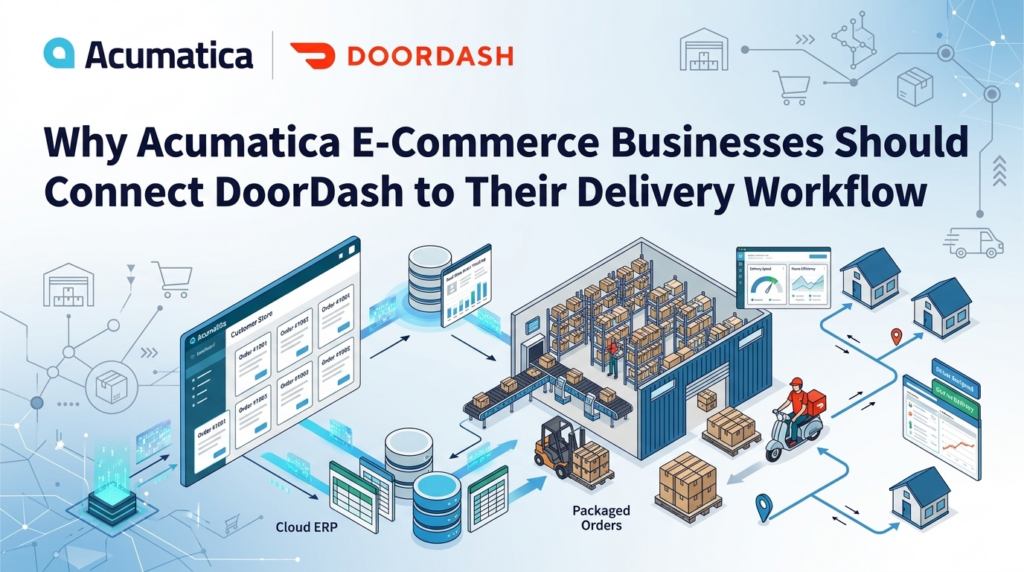
When an order is confirmed in Acumatica, the integration can automatically request a DoorDash driver, pass along the verified delivery address and order details, and pull the live tracking link and status back into the order record. The result is a single workflow that runs from checkout to doorstep without leaving the ERP.
Behind the scenes, the connection typically handles a few key jobs: triggering a delivery as soon as an order qualifies, syncing delivery status updates back to Acumatica in real time, and logging the completed delivery against the original sales order so the financial and fulfillment records stay aligned.
How This Helps the End E-Commerce Customer
It is easy to frame this integration as an internal efficiency win, and it is one. But the deeper value lands with the shopper on the other end of the order. Three things change for them in particular.
1. Real-Time Order Tracking They Can Trust
Customers want to watch their order move, not refresh a static “shipped” page. Because DoorDash feeds live status and driver progress back into the order, the buyer can see meaningful updates: the order has been picked up, the driver is on the way, and a realistic ETA is approaching. When that information flows through Acumatica into the storefront or customer portal, the shopper gets one reliable source of truth instead of being bounced to a separate courier site.
This visibility does more than satisfy curiosity. It cuts down on anxious “where is my stuff?” support tickets, reduces missed deliveries because customers know when to be available, and builds the kind of confidence that brings people back for a second order.
2. A Complete, Unified Order History
When delivery data and sales data live in the same system, every order carries its full story: what was bought, when it shipped, which driver delivered it, and when it arrived. For the customer, that means a clean order history in their account where each past purchase shows its real delivery outcome, not a vague status that stops at the warehouse door.
That unified record pays off whenever a customer needs to reorder, check a delivery date for a warranty or return, or verify that something actually arrived. Instead of contacting support and waiting, they can self-serve from a history that is accurate because it was never split across two systems in the first place.
3. Faster, More Reliable Delivery
On-demand dispatch through DoorDash means orders can move the moment they are ready, rather than waiting for a staff member to manually book a courier. For the end customer, that translates into shorter wait times and access to same-day or scheduled local delivery that a manual process could not reliably support. Speed and dependability are exactly what turn a one-time buyer into a repeat one.
The Payoff for the Business
The customer-facing wins are mirrored by clear operational gains. Automating the handoff removes data-entry errors and frees staff from app-switching, so the team can handle more orders without adding headcount. Real-time status syncing means support agents answer delivery questions from inside Acumatica instead of chasing couriers. And because every delivery is logged against its sales order, finance and fulfillment reporting stay clean, making reconciliation and performance analysis far simpler.
Perhaps most importantly, the integration lets smaller and mid-sized Acumatica sellers offer the kind of fast, trackable delivery that shoppers now expect from the largest retailers, without building a fleet or a logistics team of their own.
Bringing It All Together
For an Acumatica e-commerce business, delivery is the part of the journey where good systems often stop and manual work begins. Connecting DoorDash to the order workflow closes that gap. It automates dispatch, streams live tracking back into the system, and keeps a single, complete record of every order from cart to doorstep.
The internal efficiency is real, but the lasting advantage is the experience it gives the customer: deliveries they can follow in real time, an order history they can rely on, and the speed that earns their next purchase. In a market where the last mile decides whether a shopper returns, an Acumatica DoorDash integration is less a nice-to-have and more a competitive necessity.
Contact us today to learn how Acumatica and DoorDash can streamline your delivery workflow.