

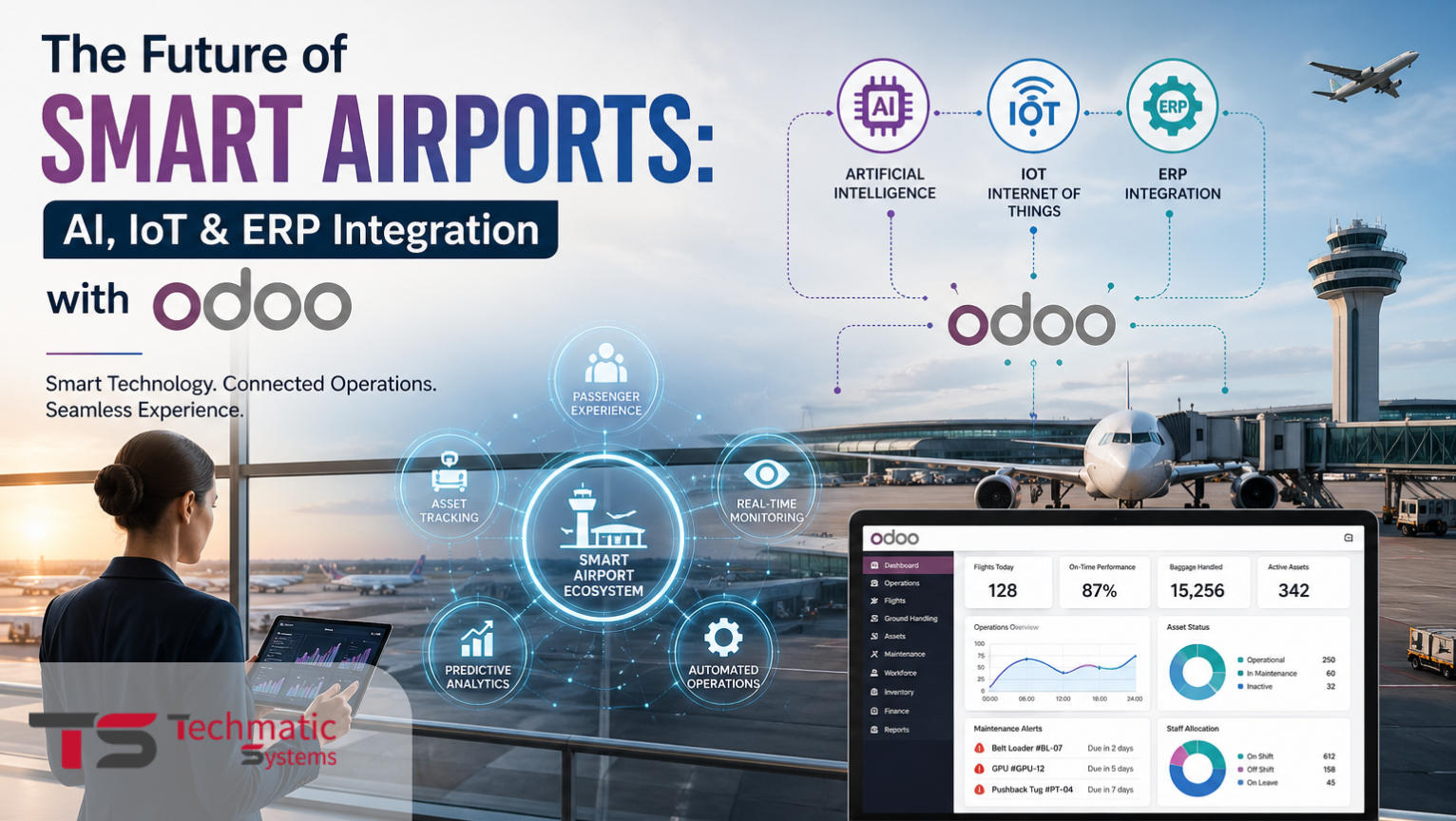
Airports today are no longer just transit hubs they are becoming intelligent ecosystems powered by technology. From managing passenger flow to tracking assets and optimizing workforce operations, modern aviation demands more than traditional systems.
This is where a smart airport management system comes into play. With the integration of AI, IoT, and ERP solutions like Odoo, airports can achieve real-time visibility, automation, and data-driven decision-making. Leading implementations, such as at Cochin International Airport, show how digital transformation is reshaping airport operations and how Odoo partners like Techmatic Systems are driving that change.
What is a Smart Airport?
A smart airport uses advanced technologies like Artificial Intelligence (AI), Internet of Things (IoT), and ERP systems to improve efficiency, safety, and passenger experience.
Instead of disconnected systems, a smart airport operates on a centralized digital platform where every operation from check-in to baggage handling is interconnected.
Key Characteristics:
- Real-time passenger and asset tracking
- Automated workflows and alerts
- Data-driven operational planning
- Seamless system integration
Challenges in Traditional Airport Management
Before adopting smart technologies, many airports struggle with:
- Disconnected systems across departments
- Manual workforce scheduling
- Poor visibility of assets and equipment
- Delayed reporting and decision-making
- High operational costs
These challenges highlight the need for a modern airport ERP system that brings everything under one unified platform.
Role of AI in Smart Airports
AI is transforming how airports predict, plan, and perform.
How AI is used in airports:
- Predicting passenger traffic and peak hours
- Optimizing staff allocation
- Detecting operational bottlenecks
- Enhancing security through intelligent monitoring
For example, AI can forecast passenger flow and help airports avoid overcrowding at terminals, improving both safety and efficiency.
How IoT is Transforming Airport Operations
IoT connects physical assets to digital systems, enabling real-time tracking and monitoring.
IoT applications in aviation:
- Baggage tracking systems
- Smart sensors for equipment health
- Vehicle and ground support tracking
- Energy and infrastructure monitoring
With IoT, airports gain complete visibility over assets, reducing downtime and improving utilization.
Why ERP is the Backbone of Smart Airports
While AI and IoT generate data, ERP systems like Odoo act as the central brain that connects and processes everything.
An airport ERP system integrates:
- Operations
- Workforce management
- Asset tracking
- Maintenance
- Finance and reporting
This eliminates silos and ensures all departments work on a unified platform.
How Odoo Powers Smart Airport Management
Odoo stands out as a flexible and scalable airport management ERP software, making it ideal for modern aviation needs.
Key Odoo capabilities for airports:
- Workforce Management
Automates staff rostering and shift planning - Asset Management
Tracks equipment, vehicles, and infrastructure in real-time - Maintenance Management
Enables preventive and predictive maintenance - Inventory Control
Manages spare parts and operational resources - Integrated Dashboards
Provides real-time insights for decision-making
Role of Odoo Partners in Airport Digital Transformation
Implementing ERP in an airport is complex it requires deep industry knowledge and technical expertise. This is where Odoo partners play a critical role. Techmatic Systems, an experienced Odoo partner and service provider, has been actively involved in delivering Odoo ERP solutions for airport environments, including optimization for operations at Cochin International Airport.
What an Odoo partner brings:
- Customized ERP implementation
- Integration with AI and IoT systems
- Workflow automation tailored to airport operations
- Ongoing support and scalability
Key Benefits of AI + IoT + ERP Integration
| Technology | Role in Airports | Benefit |
| AI | Predict passenger flow | Better planning & reduced congestion |
| IoT | Track assets & equipment | Real-time visibility |
| ERP (Odoo) | Centralized control system | Seamless operations |
Combined Benefits:
- Improved operational efficiency
- Reduced operational costs
- Better passenger experience
- Real-time decision-making
- Enhanced safety and compliance
Real-World Use Case: Smarter Airport Operations
A mid-to-large airport like Cochin International Airport can leverage Odoo to:
- Automate staff scheduling across terminals
- Monitor ground support equipment in real-time
- Track maintenance schedules proactively
- Integrate IoT sensors for asset monitoring
- Use AI insights for operational forecasting
This creates a fully connected smart airport ecosystem.
Future Trends in Airport Technology
The future of airport management is driven by innovation:
- AI-powered predictive analytics
- IoT-enabled smart infrastructure
- Advanced ERP dashboards
- Sustainable airport operations
- Automation and robotics
Airports that adopt these technologies early will gain a competitive edge in efficiency and passenger satisfaction.
Why Choose Techmatic Systems as Your Odoo Partner
Implementing an ERP system for airports requires expertise. That’s where Techmatic Systems stands out.
What Techmatic Offers:
- Customized Odoo ERP implementation for airports
- Seamless integration with AI and IoT systems
- Scalable solutions for growing airport operations
- Industry-specific expertise in automation and ERP
With the right Odoo partner, airports can unlock the full potential of smart technologies.
Take the Next Step Toward Smart Airport Management
The evolution of airports into smart, connected ecosystems is no longer optional it’s essential. By integrating AI, IoT, and ERP systems like Odoo, airports can move from reactive operations to predictive and intelligent management. With the support of experienced Odoo partners like Techmatic Systems, airports can successfully implement these solutions and unlock new levels of efficiency, scalability, and innovation.
FAQ’s
- What is a smart airport management system?
A smart airport management system uses technologies like AI, IoT, and ERP platforms such as Odoo ERP to automate operations, improve efficiency, and enhance passenger experience through real-time data.
- How does Odoo ERP help in airport operations?
Odoo ERP helps airports manage workforce scheduling, asset tracking, maintenance, and financial operations in one centralized platform, improving efficiency and decision-making.
- What role does AI play in smart airports?
AI in smart airports is used to predict passenger flow, optimize staff allocation, detect delays, and improve security through data-driven insights.
- How is IoT used in airport management?
IoT enables real-time tracking of airport assets, baggage systems, and ground vehicles through connected sensors, improving visibility and operational control.
- Can Odoo be integrated with AI and IoT systems?
Yes, Odoo ERP can be integrated with AI and IoT technologies to create a fully connected smart airport ecosystem with real-time monitoring and automation.
- What are the benefits of using ERP in airports?
ERP systems improve airport operations by centralizing data, reducing manual work, enhancing reporting accuracy, and enabling better coordination across departments.
- How do smart airports improve passenger experience?
Smart airports reduce wait times, improve navigation, and provide seamless services through automation, real-time updates, and efficient resource management.
- Why choose an Odoo partner for airport ERP implementation?
An experienced Odoo partner like Techmatic Systems ensures proper customization, seamless integration, and smooth deployment of ERP solutions for airport operations.